Chevy Chase DC vs. Chevy Chase Maryland: What's the Difference in Real Estate?

What is the difference between Chevy Chase DC and Chevy Chase Maryland real estate?
Chevy Chase DC and Chevy Chase Maryland are two distinct real estate markets separated by a boundary line — with different tax structures, jurisdiction rules, price dynamics, and property types that meaningfully affect what you buy, what you pay, and what you net at closing.
They share a name and some of the most consistently in-demand residential streets in the DC metro area. But if you're buying or selling in either Chevy Chase market and treating them as interchangeable, you're making a significant strategic error.
I've worked on both sides of that boundary line for over a decade, and the questions I hear most often from buyers and sellers are the same: Which side is better? Which holds value? Which is easier to sell? The honest answer is that it depends on what you're optimizing for — and the two markets reward different priorities.
Here's what you actually need to know.
The Boundary Line That Changes Everything
Chevy Chase DC (zip code 20015) sits entirely within Washington, DC — primarily in Ward 3, running along the western edge of the district near Western Avenue NW. Chevy Chase Maryland (zip code 20815) is a collection of municipalities and unincorporated areas just across that line in Montgomery County, including the Town of Chevy Chase, Chevy Chase Village, Chevy Chase Section 3, Section 4, and Somerset, among others.
Western Avenue NW is literally the dividing line. Two houses on the same block can be in entirely different jurisdictions — with different property tax rates, different transfer taxes, different title processes, and different market dynamics.
That boundary is not a formality. It's a financial variable.
Property Taxes: A Real Dollar Difference
This is where the two markets diverge most sharply for buyers.
DC property taxes are assessed at a flat residential rate, currently $0.85 per $100 of assessed value for owner-occupied homes. Maryland property taxes in Montgomery County combine state, county, and municipal rates — and depending on which Chevy Chase municipality you're in, the combined effective rate typically runs higher than DC's.
For a $2 million home, that difference can translate to several thousand dollars annually. Over a ten-year hold, that's a meaningful number that should factor into your buying decision — not as a dealbreaker, but as part of the full cost analysis.
Consult a tax advisor for your specific situation, as rates and assessments change and individual circumstances vary.
What the Homes Look Like
Both markets are defined by substantial single-family homes on generous lots, but the architectural profiles differ.
Chevy Chase DC
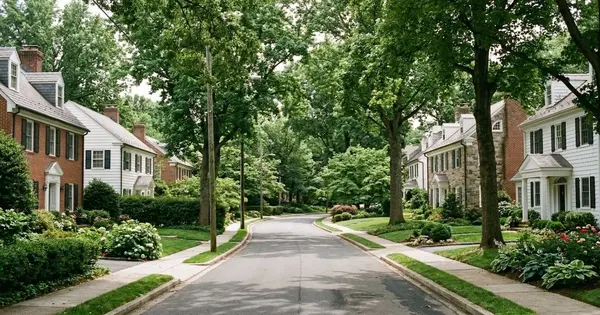
The DC side tends toward Tudor Revivals, brick Colonials, and Craftsman-style homes built largely between 1910 and 1940. Lots are typically 6,000–9,000 square feet. Many homes have been renovated extensively while retaining their original architectural character. Streets like Kanawha Street NW, Livingston Street NW, and the blocks running toward Military Road NW represent the core of the market.
Chevy Chase Maryland
The Maryland side offers more variation. You'll find everything from 1920s Colonials and Cape Cods to mid-century ranches and newer construction on larger lots. Some of the Maryland municipalities — particularly Chevy Chase Village and Somerset — feature properties on lots exceeding 10,000 square feet, with setbacks and mature landscaping that give the streets a distinctly open feel. Brookville Road, Rosemary Street, and the blocks surrounding the Chevy Chase Club corridor anchor the upper end of the market.
Price Per Square Foot and Market Velocity
This is the one section of this guide tied to a specific window. Everything else here holds regardless of when you're reading. I refresh these figures each quarter.
Most comparisons of these two markets stop at "DC costs more." The data says something more useful than that, and it runs in two directions at once.
Over the twelve months ending August 2026, 153 detached homes closed in Chevy Chase DC and 52 closed in Chevy Chase, Maryland.
| Chevy Chase DC | Chevy Chase MD | |
|---|---|---|
| Closed detached sales | 153 | 52 |
| Median sale price | $1,485,000 | $1,835,000 |
| Price range | $775,000 – $6,400,000 | $840,000 – $5,250,000 |
| Median price per above-grade sq ft | $729 | $668 |
| Median days on market | 7 | 9 |
| Median share of original asking price | 100.0% | 98.7% |
| Sold at or above original asking | 92 of 153 | 25 of 52 |
| Median lot size | 0.13 acres | 0.20 acres |
DC costs more per foot. Maryland costs more per house. The DC side commands roughly a 9% premium per above-grade square foot. But the median Maryland sale is $350,000 higher, because Maryland lots run about half again larger and the houses on them are bigger. Both are true, and which one matters depends on whether you're buying square footage or buying an address.
Where it gets practical is at the negotiating table. The median DC home sold for exactly its original asking price, and 60% of DC sellers got at or above what they first asked. On the Maryland side the median closed at 98.7% of original asking, and fewer than half of sellers held their opening number. Maryland buyers have room to negotiate. DC buyers usually don't.
The penalty for mispricing is severe on both sides, and nearly identical. Homes under contract within ten days sold at 100.3% of original asking in DC and 100.0% in Maryland. Homes that took thirty days or more sold at 91.1% in DC and 92.5% in Maryland — a give-back of roughly $130,000 to $150,000 on a typical house in either market.
That is the number worth carrying away from this page. The boundary line changes your taxes, your lot size, and your negotiating leverage. It does not change what happens when a house comes out at the wrong price.
Source: Bright MLS, closed detached single-family sales, ZIP 20015 (August 29, 2025 – August 21, 2026) and ZIP 20815 (September 15, 2025 – August 18, 2026). Retrieved August 23, 2026.
For current listings and market activity in both markets, browse Chevy Chase DC homes for sale and Chevy Chase Maryland homes for sale on my site — updated daily.
One Is a House Market. The Other Is a Condo Market.
The clearest difference between the two Chevy Chases isn't price. It's what is actually for sale.
| Closed sales, twelve months | Chevy Chase DC | Chevy Chase MD |
|---|---|---|
| Detached houses | 153 | 52 |
| Condominiums and co-ops | 25 | 150 |
They are near mirror images. The DC side is a house market with a thin condo fringe. The Maryland side is a condo market with a smaller and more expensive pool of houses. Right now there are 66 attached homes actively for sale in 20815 against 14 in 20015.
This also explains Maryland's higher detached median. Maryland's entry-level buyers are largely buying condominiums, so the detached pool that remains skews upward.
If you are shopping attached, the numbers behave completely differently.
| Chevy Chase DC | Chevy Chase MD | |
|---|---|---|
| Closed condo and co-op sales | 25 | 150 |
| Median sale price | $360,000 | $452,500 |
| Price range | $155,000 – $1,075,000 | $159,000 – $2,750,000 |
| Median days on market | 21 | 33 |
| Median share of original asking | 97.4% | 97.1% |
Detached homes in these two ZIP codes sold in 7 and 9 days at 100.0% and 98.7% of original asking. Condos took 21 and 33 days and closed at 97.4% and 97.1%. Anyone carrying detached-market expectations into a condo search — on either side of the line — will misjudge both the timeline and the negotiating room.
One more difference worth knowing: the co-ops are on the Maryland side. Every attached sale in 20015 over this period was a condominium. Maryland's Kenwood, Kenwood House and Hamlet Place are cooperatives, which is a different form of ownership with different financing, different approval processes, and sale prices that are not directly comparable to condo prices because the building's underlying mortgage sits outside the purchase price.
And Friendship Heights sits on both sides at once. Six of the DC attached sales and twenty-nine of the Maryland ones carry a Friendship Heights address. Two buildings a few hundred feet apart can be in different states, with different transfer taxes, different recordation structures, and different closing processes. If you are shopping that corridor, confirm which side of Western Avenue a building sits on before you run any numbers.
Source: Bright MLS, closed condominium and cooperative sales, ZIP 20015 and ZIP 20815, twelve months ending August 2026. Retrieved August 23, 2026.
The Buyer Decision: DC vs. Maryland
Buyers choosing between the two markets are typically weighing a few specific factors:
Choose Chevy Chase DC if:
- You want to remain within DC jurisdiction for tax or practical reasons
- You value walkability along Connecticut Avenue NW and easy access to the Friendship Heights Metro station
- You're drawn to the architectural character of pre-war brick homes
- You value the resale liquidity of DC's consistently tight inventory
- You want direct access to Rock Creek Park's trail network
Choose Chevy Chase Maryland if:
- You want more square footage or a larger lot for the price point
- You prefer the quieter, more suburban character of the Maryland municipalities
- You're open to Montgomery County's amenities and proximity to downtown Bethesda
- You're comparing across a broader price range
Neither is objectively better. They serve different priorities — and the right answer depends entirely on your situation.
The Seller Perspective
If you're selling in Chevy Chase DC, your competitive set is small and your buyer pool is motivated. DC inventory in this price range turns over slowly, which generally supports pricing. The key variable is condition and presentation — buyers at this level have options across the metro and will not overpay for deferred maintenance.
If you're selling in Chevy Chase Maryland, you're competing with more inventory but also reaching a broader buyer pool that includes buyers relocating from outside the region who are comfortable in Montgomery County. The Maryland side also benefits from proximity to Bethesda's retail and restaurant corridor, which remains a consistent draw.
In both markets, the homes that sell quickly and at or above asking price share one consistent trait: they are priced accurately from day one and presented without compromise.
FAQ
Is Chevy Chase DC or Chevy Chase Maryland more expensive?
It depends what you're measuring. On price per above-grade square foot, Chevy Chase DC runs higher — a median of $729 against $668 on the Maryland side over the twelve months ending August 2026. But the median Maryland sale price was $1,835,000 against $1,485,000 in DC, because Maryland lots run about half again larger and the houses are bigger. DC costs more per foot; Maryland costs more per house. Source: Bright MLS, retrieved August 23, 2026.
Do homes sell faster in Chevy Chase DC or Chevy Chase Maryland?
Marginally faster in DC — a median of 7 days against 9 in Maryland over the twelve months ending August 2026. The more useful difference is price: the median DC home sold at 100.0% of its original asking price and 92 of 153 sellers got at or above what they first asked, while the Maryland median was 98.7% with fewer than half of sellers holding their opening number. In both markets, homes taking thirty days or more sold at roughly 91–93% of original asking. Source: Bright MLS, retrieved August 23, 2026.
Are there condos in Chevy Chase DC and Chevy Chase Maryland?
Both, but in very different quantities. Over the twelve months ending August 2026, 150 condominiums and co-ops closed in Chevy Chase, Maryland against 25 in Chevy Chase DC — the reverse of the detached market, where DC had 153 sales to Maryland's 52. Maryland's attached inventory is concentrated in buildings along Friendship Boulevard, Connecticut Avenue and Willard Avenue, and it includes cooperatives as well as condominiums. Every attached sale in Chevy Chase DC over the same period was a condominium. Source: Bright MLS, retrieved August 23, 2026.
What should I know about closing costs when buying in Chevy Chase DC vs. Maryland?
DC and Maryland have different transfer tax and recordation tax structures, and the conventions around who pays which costs differ between the two jurisdictions. DC transfer taxes are typically split between buyer and seller; Maryland conventions can vary. Work with a local real estate attorney or title company familiar with both jurisdictions — the difference at a $1.5M+ price point is not trivial.
If you are choosing between the two because you are new to the area entirely, start with what to know before committing to a move to Washington DC. And on the DC side of the line, Upper Northwest is really four separate markets, which changes how you should approach an offer.
If you're weighing Chevy Chase DC against Chevy Chase Maryland — whether as a buyer evaluating your options or a seller positioning your home — I'd welcome the conversation. These are two markets I know in detail, and the right answer looks different for every client.
There's no pressure and no timeline but yours. When you're ready to talk through your options, I'm here.
Call or text me directly at 202.536.4043, or visit sherinemonir.com.
Related reading: Sumner, Bethesda MD · Glen Echo Heights · Bannockburn · Bethesda MD real estate · Upper Northwest DC
Sherine Monir is a luxury real estate consultant with the Sherine Monir Group at Compass, licensed in DC, Maryland, and Northern Virginia. She holds dual credentials in real estate and interior design (NCIDQ, CID, ASID) and has been serving buyers and sellers across the DC metro area since 2013.
Recent Posts