Georgetown Village, Bethesda MD Real Estate: Where the Smallest Houses Cost the Most Per Foot
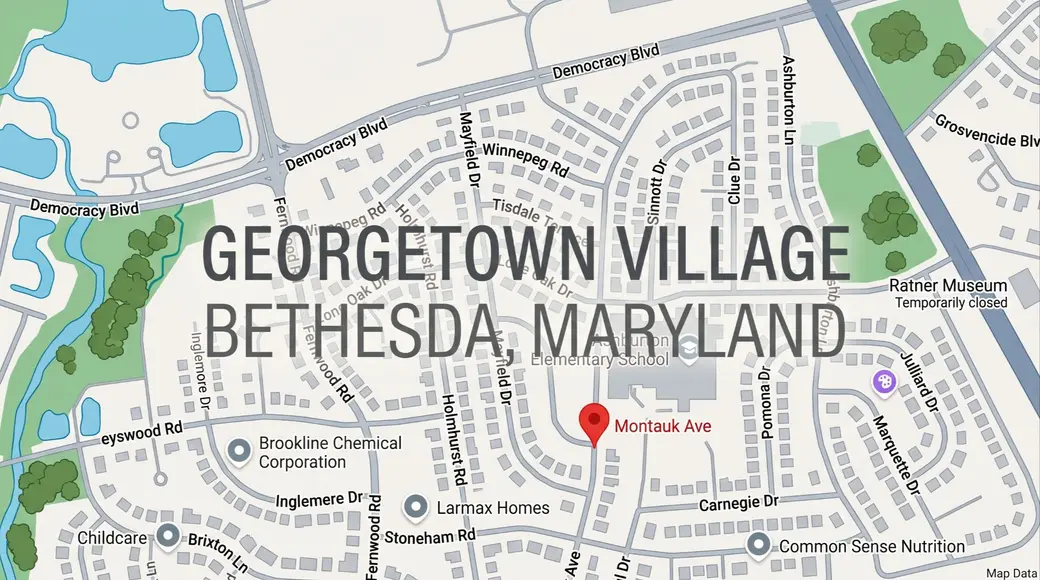
What is Georgetown Village in Bethesda, MD? Georgetown Village is a 247-home subdivision of 1950s detached houses in Bethesda MD 20817, between Democracy Boulevard and the Capital Beltway. It is a different place from Old Georgetown Village, which is a townhouse and condominium community with a Rockville 20852 address, marketed as North Bethesda.
Two houses sold in Georgetown Village last year within a few weeks of each other. One was a 1951 rambler under 900 square feet. The other was a rebuilt house four times that size. The rambler sold for roughly $875 per square foot. The larger, newer house sold for about $516.
That is not a typo, and it is not unusual here. In Georgetown Village the oldest and smallest houses command close to double the price per foot of the new construction that replaces them — because on a 0.13-acre lot, the buyer of the small house is not really buying the house.
This is a guide to what actually distinguishes Georgetown Village: which neighborhood it is (and which one it isn’t), how the Beltway ended up as its southern wall, why its per-square-foot numbers look backwards, and what that means whether you are selling an original or shopping for one.
First, You Are Probably Thinking of a Different Neighborhood
Two places in Montgomery County have nearly the same name, and they are confused constantly — by buyers, by search engines, and by more than a few agents. They are not near each other, they are not the same product, and they do not even share a postal city.
Georgetown Village — the subject of this guide — is in Bethesda, MD 20817. County subdivision 07064: 247 detached single-family houses, average year built 1955, platted between 1950 and 1960. Streets include Montauk Avenue, Mayfield Drive, Camrose Terrace, Winnepeg Road, Tisdale Terrace, Lone Oak Drive, Stoneham Road, Rockhurst Road and Bells Mill Road.
Old Georgetown Village is in Rockville, MD 20852, and is generally marketed as North Bethesda. It is subdivision 04043 — a townhouse and condominium community developed between 1977 and 1993, average year built 1980, with its own homeowners association and a separate condominium association. There is also a distinct Georgetown Village Condominium, which is a third thing again.
So the difference is not a subtle one. Different postal city, different ZIP code, different decade, and detached houses on their own lots versus attached homes with association dues and shared amenities. If you are searching listings and the results mix a $700,000 attached unit with a $1.9 million detached house, this is why.
When you tell an agent you are looking in “Georgetown Village,” say which one. The two markets have almost nothing to do with each other, and the pricing conclusions in this guide apply only to the Bethesda 20817 detached subdivision.
Sources: Old Georgetown Village HOA, Montgomery County Planning subdivision records, and recorded plats at the Maryland State Archives.
Montauk Avenue Is Named After a Company, Not a Place
The longest and most central street in Georgetown Village is Montauk Avenue. It has nothing to do with Long Island.
The subdivision was not built by one developer. It was platted in pieces between 1950 and 1960 by a rotating group of small syndicates — Richards Properties, Joseph S. Devereux and Frank A. Simon, John R. Devereux Inc., Kanh Enterprises. Among them was the Montauk Corporation, which platted Blocks A, F through H, J, N, and P through S across 1951 to 1953.
The 1952 plat sheet carries both names on the same page: the Montauk Corporation as owner, and Montauk Avenue as the street being dedicated. Land for that section came from the Truden Company and from private owners; the surveyor was Maddox & Hopkins of Silver Spring — the same firm that laid out Tulip Hill on the other side of Bethesda.
That piecemeal origin explains something you notice walking the neighborhood: the street pattern does not resolve into a single plan. Blocks meet at odd angles, and lot widths change from one street to the next. It was assembled, not designed.
Source: recorded Plat 3216, Maryland State Archives.
The Beltway Arrived After the Neighborhood, and Became Its Wall
Georgetown Village was largely built out through the 1950s. Its last section — Blocks K, L and M along Rockhurst Road — was platted in June 1960 by Kanh Enterprises, and every house on that street was built in 1961.
The Capital Beltway opened through Montgomery County in 1964.
So the southernmost strip of Georgetown Village was platted and built in the narrow window just before the highway arrived, and those houses ended up fronting what became I-495. The neighborhood’s southern boundary today is not a street or a creek. It is the Beltway.
This matters in two practical ways. Sound exposure varies sharply by how far north of the highway a house sits, and it is not something a listing photograph communicates. And the northern edge, along Democracy Boulevard, gives the neighborhood a completely different character — closer to the Davis Library, Georgetown Square, the Shops at Wildwood, and the Rock Spring office corridor directly across Democracy Boulevard.
Georgetown Village also sits in a different planning context from most of the Bethesda neighborhoods people compare it to. County records place it in the North Bethesda–Garrett Park master plan area rather than Bethesda–Chevy Chase, and virtually every parcel drains to Cabin John Creek by way of Bulls Run and Thomas Branch.
There Is No HOA and No Civic Association
This surprises people, and it is worth knowing before you write an offer.
Montgomery County’s civic association and HOA layers return no local organization for Georgetown Village. Unlike Bannockburn, which has an active cooperative and a civic association, or Merrimack Park with both a citizens association and a swim club, Georgetown Village has no registered association of any kind.
The only restrictions that run with the land are the minimum building restriction lines — setbacks — established on the recorded plats.
For a seller, that means no resale package to order, no HOA documents, no association estoppel, and no architectural review to disclose. Settlement here is simpler than in most of the Bethesda subdivisions people shop alongside it.
For a buyer, it means the same freedom cuts both ways: no design review means the house going up next door does not have to look like anything in particular. The rebuilding pattern below is the direct result.
(An informal neighborhood group that has never registered with the county is always possible. What is verifiable is that none is on record.)
The Numbers: Twenty-One Sales, October 2024 Through July 2026
This is the one section of this guide tied to a specific window. Everything above holds regardless of when you are reading. I refresh these figures each quarter.
Twenty-one homes closed in the Georgetown Village subdivision between October 2024 and the end of July 2026, totaling $28.3 million. The median sale price was $1,350,000 — a number that describes no actual house in the neighborhood, because Georgetown Village trades as three separate markets.
| Oct 2024 – Jul 2026 | Original, under 1,100 sq ft | Expanded original | New build, 2010+ |
| Sales | 8 | 2 | 11 |
| Median sale price | $820,000 | $1,056,000 | $1,869,000 |
| Price range | $700K – $895K | $837K – $1.275M | $1.35M – $1.97M |
| Median above-grade sq ft | 960 | 1,848 | 3,588 |
| Median price per sq ft | $875 | $565 | $516 |
| Median days on market | 6 | 18 | 18 |
| Median share of original asking | 102.3% | 95.1% | 98.4% |
| Sold at or above original asking | 6 of 8 | 0 of 2 | 5 of 11 |
The Smallest Houses Are the Most Expensive Real Estate
The original ramblers sell at $875 per square foot. The new construction that replaces them sells at $516. The oldest, smallest houses in Georgetown Village carry a roughly seventy percent premium per foot over the largest, newest ones.
They also sell faster — a median of six days against eighteen — and they are the only tier that consistently beats its asking price. Six of eight closed at or above original list.
None of that is a statement about the houses. On a 0.13-acre lot inside the Beltway with public sewer, the land carries most of the value, and the rambler standing on it is a scheduling problem to the buyer rather than an asset. Small house, high price per foot. The arithmetic is doing exactly what you would expect once you know what is being bought.
The Middle Tier Is the Hard Sale
Look at the narrow column. The expanded original — the 1950s house that a previous owner added onto, finished a basement in, and modernized — is the only tier that failed to reach asking. Both sales closed under, at a median of 95.1% of original list, and took three times as long as the ramblers.
Two sales is a small sample and I will not overstate it. But the current pipeline says the same thing. Of the four properties on the market or under contract right now, the two that have been sitting longest are both expanded originals, and both have cut their price — one from the mid-$1.3 millions after nearly three months, the other from the mid-$1.5 millions after almost three months. The two moving normally are a recent build that went under contract at full asking in about a week, and one more expanded original that needed a reduction to get there.
The reason is structural. An expanded 1950s house is too improved to be priced as land and too compromised to compete with a 2025 build at a similar number. It sits between two buyer pools and belongs to neither.
If you own one of these, that is the single most important thing to know before you set a price.
The Rebuilding Is Accelerating
Of 247 parcels in the subdivision, 45 date to 2000 or later — and twenty-three of those were built in the 2020s. The current decade has already out-produced the entire 2010s and is not finished. Activity concentrates on Montauk Avenue, which accounts for seven of the twenty-one sales, with clusters on Camrose Terrace and Lone Oak Drive.
The original housing stock has a median above-grade area of about 1,264 square feet on a median lot of 5,840 square feet (0.13 acre) — the smallest original houses and smallest lots of any Bethesda subdivision I track. That combination inside the Beltway is precisely what drives teardown economics.
One caution on the new-build tier: the weakest result in the entire dataset was a house built in 2016 that closed at 90% of its original asking price after 74 days. Ten-year-old construction now competes against 2025 and 2026 product on the same streets, and it is not winning on finish. New is a depreciating adjective here.
What Is In the Pipeline Now
Four properties are on the market or under contract, at a median asking price of about $1.45 million and a range from roughly $1.29 million to $1.55 million. Three of the four are expanded originals; one is a 2019 build. There is currently no original rambler available.
That is the normal state of things. The entry-level houses do not sit.
Source: Bright MLS closed sales records, Georgetown Village subdivision, Bethesda MD 20817, October 2024 through July 2026. One duplicate comp-only MLS entry was excluded. Sale-to-list figures are measured against original list price, not a reduced one.
If You Are Selling an Original House Here
The instinct is to renovate before listing. In Georgetown Village that instinct is usually wrong, and the numbers say so.
A significant share of your likely buyers intend to remove the house. Money spent on a kitchen, on flooring, on a bathroom remodel is money spent on something that will be demolished — and it does not move the land value, which is what is actually being bid on.
What does matter:
- Site legibility. Buyers evaluating a lot need to see the lot. Clearing overgrowth, exposing the rear yard and making the grade and tree situation visible does more than any interior work.
- Anything that affects buildability. Existing survey, septic-to-sewer status, easements, mature trees subject to county protection, and the setback lines from your recorded plat. Have these in hand before you list. Every builder will ask.
- The competitive window. Original houses here go under contract in a median of about five days, at or above asking. That speed is an asset only if the property is exposed properly to the full buyer pool in the first week. An off-market deal in this subdivision usually leaves money behind.
If your house is one of the renovated or rebuilt ones, the advice inverts entirely — you are selling a finished home to a family that wants to move in, presentation carries real weight, and you should expect a slower, more negotiated sale. This is where design work genuinely pays. I hold NCIDQ certification and a master’s in interior design, and the honest counsel is often to spend less than sellers expect and to spend it in different places.
If You Are Buying Here
Decide early which of the two markets you are in, because they demand different tactics.
Buying an original to live in means competing with builders who can close fast, waive contingencies and value the property purely as land. You will not usually win on price alone; you win on terms and speed.
Buying an original to build on means underwriting the lot, not the house — and doing it before you offer, because you will not have time afterward.
Buying a finished rebuild puts you in a much more ordinary negotiation. Those sales took a median of two weeks and closed below asking. There is room to work.
In all three cases, look carefully at how far north of the Beltway the property sits, and visit at more than one time of day.
Frequently Asked Questions
Is Georgetown Village the same as Old Georgetown Village?
No, and they are not even in the same postal city. Georgetown Village is about 247 detached single-family houses built mostly in the 1950s, in Bethesda MD 20817. Old Georgetown Village is a townhouse and condominium community developed between 1977 and 1993 with a Rockville MD 20852 address, usually marketed as North Bethesda, and it has its own homeowners and condominium associations.
What do homes sell for in Georgetown Village, Bethesda MD?
Between October 2024 and July 2026, twenty-one homes closed at a median of $1,350,000. That median hides a three-way split: original ramblers sold between $700,000 and $895,000, expanded originals between about $837,000 and $1.275 million, and new construction between $1.35 million and just under $2 million.
Does Georgetown Village have an HOA?
No homeowners association or civic association is registered with Montgomery County for Georgetown Village. The only restrictions running with the land are the building setback lines on the recorded plats. There is no resale package or HOA document order required to sell.
Why do the small houses cost more per square foot than the big ones?
Because buyers of the original houses are largely buying the lot. On a 0.13-acre parcel inside the Beltway, the land carries most of the value, so a small house on it produces a high price per foot — a median of $875, against $516 for new construction. The larger rebuilt homes spread a bigger number across far more square footage.
Thinking About Georgetown Village?
Whether you own an original house and are trying to work out what it is actually worth to a builder, or you are looking at a rebuild and want to know how much room there is in the price, the useful conversation starts before there is a deadline attached.
Call or text Sherine directly at 202.536.4043 — or visit sherinemonir.com to get started.
Sherine is here whenever you’re ready.
Related
Recent Posts