Wesley Heights, Washington DC Real Estate: Named for a University That Did Not Exist Yet
What is Wesley Heights in Washington, DC?
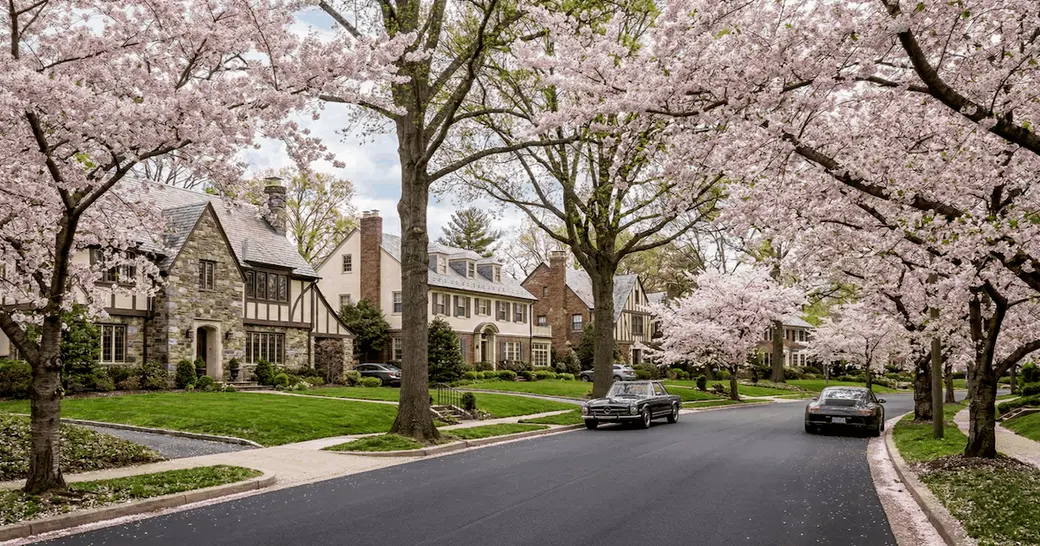
Wesley Heights is a neighborhood in Upper Northwest DC, ZIP 20016, on high ground between American University and Glover-Archbold Park. It holds three quite different kinds of housing: 1920s and 1930s detached houses, a set of gated townhouse communities built in the late 1970s, and a cluster of condominium buildings along Cathedral Avenue near New Mexico Avenue, with more along New Mexico and Massachusetts Avenues.
Here is the strange part. The name was printed on a sales map in 1890, advertising lots "adjoining new Methodist university." The university it was named for did not exist yet. American University would not be chartered until 1893 and would not hold its first classes until 1914.
The 1890 venture failed. Its promoter's estate was in bankruptcy by 1908, and the land sat largely unbuilt for another generation. The neighborhood you can actually walk through today was built starting in 1923 by a different company entirely.
So Wesley Heights was named, platted and sold thirty-three years before it was built, for a school that had not been founded. That gap explains more about this neighborhood than any of the usual descriptions do, and it is the thread running through this guide: where the boundary actually is (nobody agrees), what protects the houses (not what you would guess), what sits on the northern edge that a buyer should check, and what the last two years of sales say about a place that trades as three separate markets at once.
Where It Actually Is, and Why Nobody Agrees
Start with something most guides will not tell you: the District of Columbia does not draw an official Wesley Heights boundary.
DC's Office of Planning publishes neighborhood data, but its Wesley Heights record is a single map point for label placement, not a shape. Its broader "neighborhood cluster" lumps Wesley Heights together with Spring Valley, the Palisades, Foxhall Crescent, Foxhall Village and the Georgetown Reservoir, and the agency says plainly that those clusters do not represent neighborhood boundaries. Every line you will ever read for Wesley Heights is somebody's opinion, a zoning line, or an advisory neighborhood commission line.
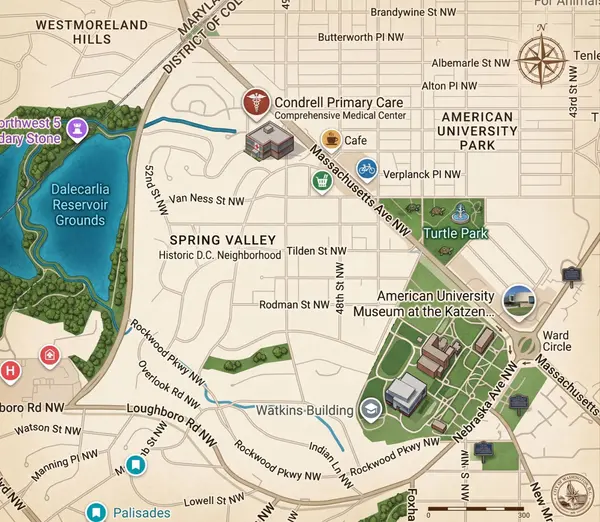
The narrative descriptions genuinely conflict, and the conflict has money in it. Most accounts put American University and Nebraska Avenue on the north, Glover-Archbold Park on the south, and Battery Kemble Park on the west. Glover Park lies on the other side of Glover-Archbold Park. The east is where they split: some draw the line at New Mexico Avenue, others at Massachusetts Avenue. That strip, together with Cathedral Avenue running west from it, is where most of the townhouse and condominium product sits. Draw the line one way and a good deal of it is in Wesley Heights; draw it the other and it is not. The townhouse community's own governing body places itself inside the neighborhood.
Practically, this matters when you search. Depending on which portal page you land on, a Wesley Heights search can return this neighborhood alone or several neighborhoods blended together, and nothing on the page tells you which. If you are shopping here, work from an actual Wesley Heights listing search rather than a portal's neighborhood filter.
Two search traps worth knowing. There is an apartment building on Cathedral Avenue literally named Wesley Heights, which indexes as its own page. And the "Wesley Heights Historic District" that ranks at the top of a general search is in Charlotte, North Carolina. Neither has anything to do with this neighborhood.
The "Heights" is not decorative. The high ground here runs to roughly 394 feet above sea level, with about 150 feet of relief inside the neighborhood itself. Point Reno, the highest natural point in the District, is 409 feet. Wesley Heights crests within about fifteen feet of the top of Washington. That is why the streets curve — Rockwood Parkway, Glover Drive, Hawthorne Lane, Dexter Terrace, Forest Lane — instead of running the DC grid. The layout was cut into the hill, not stamped onto it.
Its neighbors are Spring Valley directly north across Nebraska Avenue, Foxhall and the Palisades to the south and southwest, Berkley toward Foxhall Road, and Kent further west. All of them sit in the same advisory neighborhood commission.
The Neighborhood Was Sold Twice, Thirty-Three Years Apart
1890. A syndicate led by the real estate broker John F. Waggaman, financed by Charles C. Glover of Riggs Bank, laid out Wesley Heights on land that had been part of an older tract. Waggaman and Glover were also pushing to site the new Methodist university just to the north, which is where the name came from — John Wesley, founder of Methodism. By 1892 Glover had built his own country house, Westover, on the ridge.
The Library of Congress holds two copies of the sales map. One of them, the catalogue notes, is annotated in pencil, fold-lined, and extensively rubber-stamped: Sold. A working broker's map, carried in a pocket, marked lot by lot.
It did not hold. Waggaman's estate was in bankruptcy by 1908 and only a handful of houses were ever built — one 1891 house survives on Foxhall Road, originally with an observation tower that has since been removed. DC's own land records still carry the residue: three squares in the southeast corner of the neighborhood are recorded to December 8, 1890, and nothing was built on most of them for decades.
1923. The W.C. and A.N. Miller Development Company — brothers William and Allison Miller, in business since 1912 — bought about eighty acres and began the subdivision that actually produced the houses standing today. Wesley Heights was their first subdivision. Spring Valley followed in 1925, on land bought from American University. They marketed it as "The Garden Spot of Washington," ran a shuttle bus down to the Wisconsin Avenue streetcar, and built a community clubhouse.
There was no master architect for the layout. The Miller company used in-house architects — Gordon E. MacNeil, who joined in 1914, then Edward R. Spano from 1929 — designing house by house. You will see Wesley Heights described as one of the first master-planned communities in America; that claim traces only to promotional and secondary sources, not to any planning record, and I would not repeat it to a buyer.
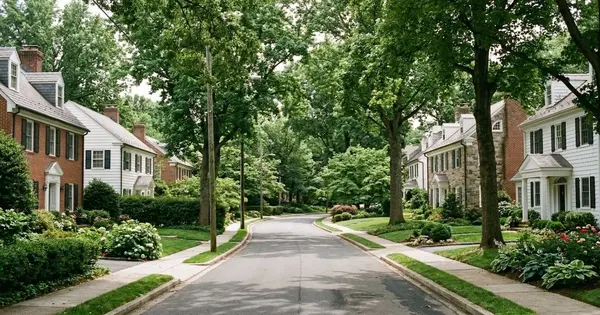
What the Millers built is what still sets the character: Tudors, Colonials, Federals and Cape Cods on generous rectangular lots, curved into the topography.
Sources: "Wesley Heights, adjoining new Methodist university," Howell & Greenough, 1890, Library of Congress Geography and Map Division; square recordation dates from the DC Office of the Surveyor; DC Office of Planning neighborhood boundary layers.
It Is Not a Historic District. It Has Something Rarer.
Wesley Heights is not a historic district — not local, not National Register — and none has ever been proposed for it. I checked the DC Inventory of Historic Sites and the list of pending nominations; there is nothing.
Exactly one designated landmark sits inside the neighborhood: the Wesley Heights Community Club on 45th Street, built by the Millers in 1927 to their company architect's design, originally housing clubrooms, a grocery, a pharmacy with a postal substation and the Miller real estate office. It was designated in 1997. Designated resources ring the neighborhood on every side — Glover-Archbold Park, Battery Kemble, the Spring Valley Shopping Center, Foxhall Village — but not inside it.
So there is no historic preservation review here. You do not need approval to change a window, a door, a roof or a paint color, the way you would in Georgetown or Foxhall Village.
What Wesley Heights has instead is its own zoning district. Of the roughly one hundred and sixty zoning codes in the District, only three residential ones are named for a neighborhood: Georgetown, Foxhall, and Wesley Heights. Georgetown got one because it is a federally recognized historic district. Wesley Heights got one because residents asked for it — the neighborhood's own historical society initiated it, and the Zoning Commission adopted it on July 13, 1992.
What it does, in plain terms:
- A house can cover no more than 30 percent of its lot
- Height is capped at 40 feet and three stories
- A 25-foot rear yard is required
- And the one that really governs a teardown: the front of a new house must fall within the range of the front setbacks already on that side of the block. You cannot push a new house forward of its neighbors. The streetwall is locked to what is already built
There are two versions. The northern strip requires lots of at least 5,000 square feet and 50 feet of width; the larger southern portion requires 7,500 square feet and 75 feet. If you are looking for the big-lot product, you are looking south.
This is the reverse of Georgetown, and it is the single most useful thing to understand before you renovate here. Your finishes are nobody's business. Your envelope is tightly capped. It is also why Wesley Heights has not seen the lot-filling rebuilds that have reshaped other Ward 3 streets — and why, when a rebuild does happen, it tends to be a very large house on a very large lot rather than a maximized box on an ordinary one. If you are weighing that kind of project, the trade-offs are the same ones in selling as-is versus renovating first.
One more wrinkle for anyone reading the code: the zone was renamed twice. It began as R-1-A/WH and R-1-B/WH in 1992, became R-14 and R-15 in the 2016 rewrite, and was renamed back to R-1A/WH and R-1B/WH in 2023. Some published material still uses the middle set of names.
Sources: DC Inventory of Historic Sites and pending nominations, DC Office of Planning; ANC 3D's Wesley Heights overlay documents; DC Zoning Commission zone conversion table.
The Park at the Bottom of the Hill Was Almost a Highway
Glover-Archbold Park forms the southern edge — 183 acres by the National Park Service's count, with a trail running nearly two and a half miles from Van Ness Street down to the Foundry Branch trail and on to the C&O Canal towpath. It is dirt the whole way and hiking only; bicycles are not permitted. Charles Glover and Anne Archbold donated the land in 1924 to be used as a bird sanctuary.
The donation reserved a hundred-foot right-of-way for a parkway through the valley, and for forty years the District tried to use it. In 1947 a senator proposed a four-lane divided highway through the park. By the late 1950s the plan had grown to a four-lane road fed by an eight-lane Three Sisters Bridge. In 1961 Anne Archbold and Charles Glover's son sued the District Commissioners to stop it — the donors' own family, suing the city over the land they had given it. The right-of-way finally went to the National Park Service in 1967.
So the quiet wooded edge that makes these streets feel the way they do exists because the donors' heirs went to court. And the Millers were selling lots facing what buyers were told would eventually be a parkway.
On the western edge, Battery Kemble Park holds an actual Civil War fort, completed in the autumn of 1861 with two 100-pounder guns covering Chain Bridge and the Virginia shore. The parapet and gun positions are still visible, and there is a trailhead there for the Potomac Heritage Trail.
One correction to a claim you will see in listings: the Capital Crescent Trail is not adjacent. Its Georgetown terminus is a little over two miles from the middle of the neighborhood. The real off-road connection from Wesley Heights is down through Glover-Archbold to the towpath, which is about three quarters of a mile away.
Distances, measured straight-line from the middle of the neighborhood: Ward Circle and American University a little over half a mile; the C&O Canal towpath at Fletcher's Cove about three quarters of a mile; Sibley Memorial Hospital about 1.2 miles; the nearest Metro, Tenleytown-AU on the Red Line, about 1.4 miles; Georgetown about 2.1 miles; downtown about 3.5 miles. There is no Metro station in Wesley Heights, and that is the honest trade for the quiet.
Sources: National Park Service, Glover-Archbold Park and Battery Kemble; parkway history from Glover Park History. Distances are straight-line and computed; driving and walking distances are longer.
The Numbers: 159 Sales, September 2024 Through August 2026
This is the one section of this guide tied to a specific window. Everything above holds regardless of when you are reading. I refresh these figures each quarter alongside the Wesley Heights market data.
One hundred fifty-nine homes closed in Wesley Heights over those twenty-four months, totaling $230.3 million. The median was $835,000 — and that number is worse than useless, because it sits in the gap between three markets that barely acknowledge each other.
| Sep 2024 – Aug 2026 | Detached houses | Townhouses | Condos & co-ops |
|---|---|---|---|
| Sales | 42 | 14 | 103 |
| Median sale price | $2,850,000 | $1,370,000 | $440,000 |
| Price range | $1.10M – $12.5M | $910K – $1.52M | $210K – $2.10M |
| Median above-grade sq ft | 3,202 | 2,009 | 1,184 |
| Median price per sq ft | $842 | $710 | $376 |
| Median lot | 0.21 acres | 0.02 acres | — |
| Median days on market | 17 | 25 | 29 |
| Median cumulative days | 20 | 27 | 40 |
| Median share of original asking | 95.9% | 99.3% | 96.0% |
| Sold at or above original asking | 12 of 42 | 7 of 14 | 27 of 103 |
| Median year built | 1935 | 1979 | 1960 |
Two Thirds of the Sales Are Condos. A Quarter of the Money Is.
Start here, because it is the fact that reorders everything else. Wesley Heights has a reputation built on its detached houses, and those account for 42 sales out of 159. The condominium and cooperative market is 103 sales — nearly two thirds of everything that trades — and it accounts for roughly a quarter of the dollars.
Fifty-nine of those condo sales closed under $500,000. Twelve closed above $1 million. It is not one market with a wide range; it is a stack of buildings from different decades that happen to share a ZIP code with some of the most expensive houses in the District.
And it is not really one condominium market either. Which street the building sits on tells you most of what you need to know:
- Cathedral Avenue — 65 of the 103 sales. Buildings from 1957 and 1960, median $367,500, about $339 per square foot, and a median 50 days on market
- New Mexico Avenue — 14 sales. Buildings from 1959 and 1979, median $577,500, about $476 per square foot, 12 days
- Sutton Place — 10 sales. Built 1980, median $860,000, about $627 per square foot, 24 days
- Massachusetts Avenue — 14 sales. Buildings from 1951, 1971 and 1988, median $1,212,500, about $630 per square foot, 10 days
Two thirds of all condominium activity in Wesley Heights happens in the Cathedral Avenue buildings, at roughly half the price per foot of the Massachusetts Avenue and Sutton Place product — and it takes four to five times as long to sell. A buyer who says "a condo in Wesley Heights" and a seller who says the same thing may be describing markets that behave nothing alike.
That is where the friction in the aggregate figures comes from. Median days on market across all condominium sales was 29, but median cumulative days was 40 — and 41 of the 103 sales carried more than sixty cumulative days. That gap is relistings: units that came off and went back on. Financing is part of the story in any older building, which is worth understanding before you write, and it is covered in more detail in my post on what the Fannie Mae condo rules mean for DC buyers and sellers.
The Townhouses Are the Tightest Market in the Neighborhood
Fourteen townhouse sales, all in communities built between roughly 1978 and 1984, and they behave differently from everything around them. Median 99.3 percent of original asking — and seven of the fourteen closed at or above it. Neither of the other two markets came close.
These are gated, association-governed communities on very small lots, and one of them is not a condominium or a conventional homeowners association at all but a private non-profit corporation with an elected board and owner-only membership. If you are buying one, read the governing documents rather than assuming; the structure is unusual and it affects what you are actually buying.
The strength of the numbers reflects scarcity more than heat. Fourteen sales in two years, in a product type with a fixed unit count and no possibility of more being built, is a market where a seller with a well-prepared house is negotiating from a genuinely strong position.
The Old Houses Still Beat the New Ones Per Foot
Among the detached houses, the pattern from my Bethesda work shows up again. The pre-1940 originals — 28 sales — ran about $871 per square foot at a median of roughly $2.78 million. The four houses built since 2000 ran about $742 per square foot, at a median of $4 million on a median 5,388 square feet.
The newer houses cost more in total and less per foot, because a buyer of an original is buying position and ground as much as building. It is the same inversion I found in Tulip Hill, and the reasoning transfers directly to anyone weighing new construction against an older house in this part of the city.
The detached market is also where buyers negotiate. Median 95.9 percent of original asking, and only 12 of 42 closed at or above it. That is a meaningfully softer number than the townhouses, and it is the single most important thing for a seller here to price around. Where you set the opening number matters more than most sellers expect — that decision is its own subject.
Lots ran from about 0.06 to 1.10 acres, with a median of 0.21 and a quarter of them above 0.28. Seven houses closed above $5 million and eighteen above $3 million, up to a 2021-built house of about 11,000 square feet on 1.1 acres that closed above $12 million. That is the top of this market, and it is thin.
What Is Actually For Sale Right Now
Fifty-five properties were on the market or under contract as this was written — 42 of them condominiums, 12 fee simple, with a median asking price just under $400,000. Against a run rate of about 6.6 sales a month, that is roughly eight months of supply, and the great majority of it is the condo market.
For a buyer, that means the condo inventory gives you time and room to negotiate, and the detached inventory does not. For a seller of a house, it means your real competition is not what is listed in Wesley Heights this week — it is the handful of comparable houses across Spring Valley, American University Park and the Palisades that your buyer is also walking through.
A Note on the Sample
These are closed sales pulled from Bright MLS for the Wesley Heights subdivision. I excluded parking spaces and storage units, which trade separately here and would otherwise drag the condo figures down. The townhouse tier rests on fourteen sales and the new-construction comparison on four, so treat those directions as reliable and the exact medians as indicative.
Off-market sales are a real factor in this neighborhood. Some transactions here never reach the MLS at all, which means the public record understates activity and removes comparables from everyone's view, including yours.
Source: Bright MLS closed sales records for the Wesley Heights subdivision, Washington DC 20016, September 2024 through August 2026. Sale-to-list figures are measured against original list price, not a reduced one. Individual sale figures are rounded.
If You Are Selling in Wesley Heights
Four things are specific to this neighborhood.
- Know which of the three markets you are in, because they price nothing alike. A detached house, a townhouse and a condominium in Wesley Heights share a ZIP code and almost nothing else — different buyers, different timelines, different negotiating positions. A valuation built on the right comparable set is worth more here than in a neighborhood where everything is the same product.
- If you are selling a house, price for a negotiation. The median detached sale closed at 95.9 percent of its original asking price and only twelve of forty-two got full ask. That is not a market that corrects an aggressive number quickly; it is one that lets a listing sit and then trades below where it started. My seller's roadmap walks through how that sequence unfolds.
- If you are selling a condominium, the building sells before the unit does. Buyers here are reading the year, the reserves and the financing before they look at your kitchen. Get the association's documents in order early — that is where the forty-day cumulative median comes from.
- Know your envelope. Any buyer thinking about adding on will ask what the Wesley Heights zoning allows — the thirty percent lot coverage, the forty-foot cap, the block-matched front setback. Having a survey and a straight answer ready is worth real money with the buyer pool that is underwriting an expansion.
On presentation: the 1920s and 1930s houses here reward being shown properly and punish being shown badly, and the difference is mostly light, sightlines and editing rather than money. I hold NCIDQ certification and a master's in interior design, and the honest counsel in a house like this is usually to spend less than sellers expect and spend it in different places than they expect. That is the thinking behind the concierge pre-listing model I use across Upper Northwest DC.
If you are earlier than that — still deciding whether to sell at all, or working out what you would actually net after DC transfer and recordation taxes — start there. And when you begin interviewing, these are the questions worth asking any listing agent.
If You Are Buying in Wesley Heights
Decide which market you are actually shopping. The three tiers here have almost no overlap. A buyer who searches "Wesley Heights under $600,000" and a buyer who searches "Wesley Heights over $2 million" are looking at the same map and two unrelated markets.
In a condominium, underwrite the building first. Price per square foot ran from about $339 in the Cathedral Avenue buildings to about $630 on Massachusetts Avenue. Reserves, special assessments and financing eligibility decide more of your outcome than the finishes will.
In a house, read the survey and the zoning before the kitchen. Thirty percent lot coverage, three stories, forty feet, a twenty-five-foot rear yard and a front line matched to your block are what determine whether the addition you have in mind is possible at all. There is no preservation review to worry about — the constraint is the envelope.
And check how the listing is filed. Because the eastern boundary is genuinely disputed, a search set to Wesley Heights can miss real inventory without telling you. It is worth watching everything on the market in Wesley Heights alongside the surrounding neighborhoods, and reading this guide against the wider Upper Northwest DC market before you decide what a Wesley Heights address is worth to you. The buyer's roadmap covers the rest of the sequence.
Frequently Asked Questions
Where is Wesley Heights in Washington, DC?
Wesley Heights is in Upper Northwest DC, ZIP 20016, on high ground bounded roughly by American University and Nebraska Avenue on the north, Glover-Archbold Park on the south, and Battery Kemble Park on the west. The eastern boundary is disputed: some sources place it at New Mexico Avenue and others at Massachusetts Avenue, which determines whether the townhouse and condominium communities are counted as part of the neighborhood. The District does not publish an official boundary for it.
Is Wesley Heights a historic district?
No. Wesley Heights is not a local or National Register historic district, and no historic district has ever been proposed for it. There is no historic preservation review of exterior alterations. The only designated landmark inside the neighborhood is the Wesley Heights Community Club, built in 1927 and designated in 1997. What regulates building here is a zoning overlay adopted in 1992, not preservation law.
What is the Wesley Heights zoning overlay?
It is a set of development standards written for Wesley Heights alone, adopted by the DC Zoning Commission in July 1992 at the initiative of neighborhood residents. It caps lot coverage at 30 percent, limits height to 40 feet and three stories, requires a 25-foot rear yard, and requires the front of a new house to line up within the range of existing front setbacks on the same side of the block. Wesley Heights is one of only three DC neighborhoods with a residential zoning district named after it, alongside Georgetown and Foxhall.
Who built Wesley Heights?
Two different parties, thirty-three years apart. A syndicate led by broker John F. Waggaman and financed by Charles C. Glover platted and named Wesley Heights in 1890, but the venture failed and Waggaman's estate was in bankruptcy by 1908, leaving the land largely unbuilt. The W.C. and A.N. Miller Development Company bought about eighty acres and began the subdivision that produced today's houses in 1923 — their first subdivision, followed by Spring Valley in 1925. The Miller company used in-house architects rather than a master planner.
Why is it called Wesley Heights?
For John Wesley, the founder of Methodism, in reference to the Methodist university being planned next door. The 1890 sales map is titled "Wesley Heights, adjoining new Methodist university." American University was not chartered until 1893 and did not hold classes until 1914, so the neighborhood was named for an institution that did not yet exist. "Heights" is literal: the high ground reaches about 394 feet, within roughly fifteen feet of the highest natural point in the District.
What do homes sell for in Wesley Heights, DC?
159 homes closed between September 2024 and August 2026, totaling $230.3 million at a median of $835,000 — but that median describes no actual property, because the neighborhood trades as three markets. Detached houses had a median of $2,850,000 and ranged from $1.10 million to $12.5 million. Townhouses had a median of $1,370,000. Condominiums and cooperatives had a median of $440,000 and made up 103 of the 159 sales.
Does Wesley Heights have an HOA?
It depends on which part. The detached houses are not governed by a homeowners association. The townhouse communities and the condominium buildings each have their own governance, and the structures vary more than buyers expect — one of the townhouse communities is a private non-profit corporation with an elected board rather than a condominium or a conventional HOA. Read the governing documents for the specific property rather than assuming.
Is there a Metro station in Wesley Heights?
No. The nearest is Tenleytown-AU on the Red Line, about 1.4 miles away in a straight line. Bus service runs along the northern and western edges and on Wisconsin Avenue. Georgetown is about 2.1 miles away and downtown about 3.5.
Thinking About Wesley Heights?
Whether you own one of the original Miller houses and want to understand what it is worth to a buyer who is underwriting an addition, or you are looking at a condominium here and want a straight read on the building before you write, the useful conversation starts before there is a deadline attached. You can begin with a no-obligation valuation or simply get in touch.
Call or text Sherine directly at 202.536.4043 — or visit sherinemonir.com to get started.
Sherine is here whenever you're ready.
Recent Posts