Spring Valley, Washington DC Real Estate: Two Markets on the Same Streets
What are homes selling for in Spring Valley, Washington DC, and does new construction play by different rules?
Over the two years ending September 2026, houses in Spring Valley, DC 20016 sold at a median of $2,600,000 after 10 days on the market. Existing houses sold at a median $2,395,000 in 7 days, at 100% of their original asking price. New construction sold at a median $4,637,500, but took a median 53 days and closed at 94.5% of asking.
That split is the most useful thing to understand about Spring Valley right now. On the same curving streets, an original 1930s Colonial and a newly built house behave like two different markets. The first sells quickly to buyers who have been waiting for the right house. The second has a much smaller pool of buyers and more room to negotiate.
This guide covers how Spring Valley was built, what the houses are, what the Bright MLS closed sales records show, what changed in the past year, and the one question almost every buyer asks here: the Army cleanup. For a look inside one of the neighborhood's renovated houses, see my Spring Valley home tour.
Where Spring Valley Sits
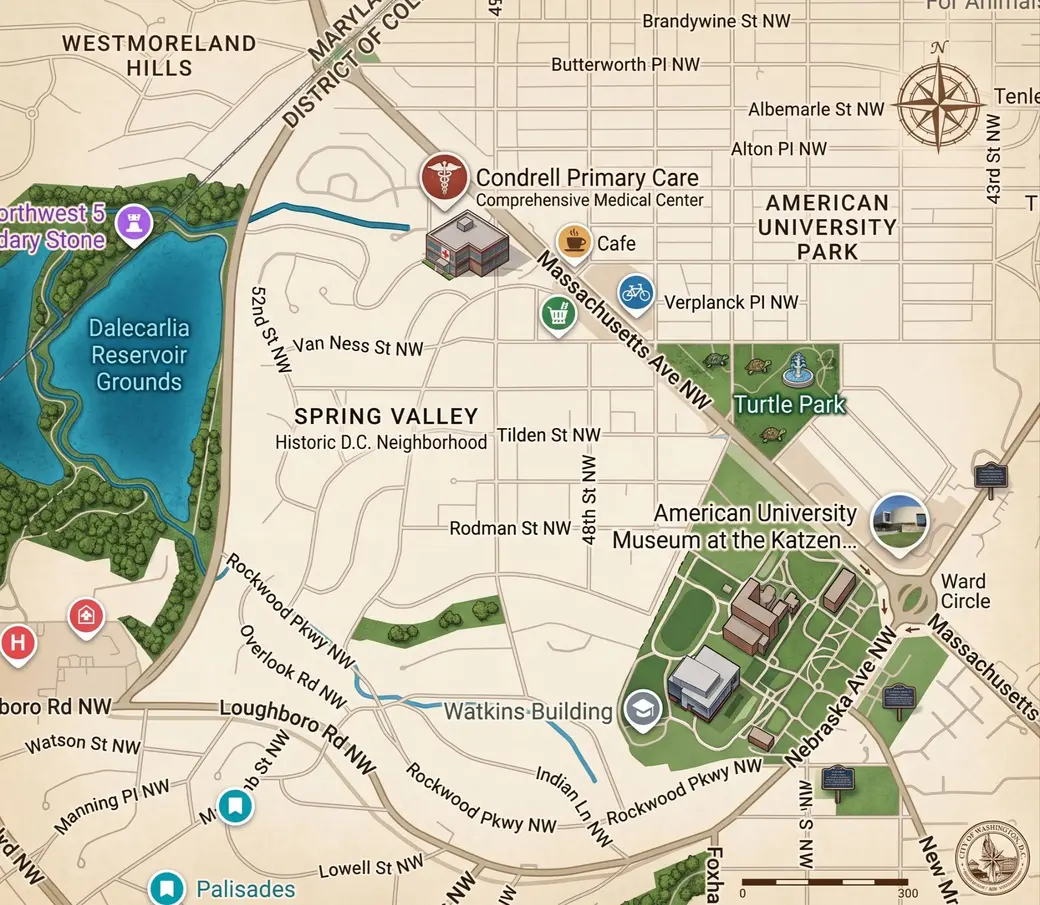
Spring Valley is in the far western corner of Upper Northwest DC, between Dalecarlia Parkway and the American University campus. Massachusetts Avenue runs through its northern part and carries the neighborhood's shops. Wesley Heights borders it to the south, and American University Park and Kent are nearby.
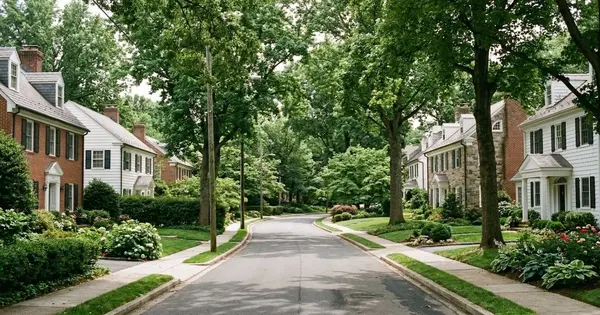
The streets curve with the hills rather than following a grid. Rockwood Parkway, Hillbrook Lane, Indian Lane, Woodway Lane, Quebec Street, Tilden Street and Sedgwick Street all run through the neighborhood.
Built by the Miller Company
Spring Valley was developed by W.C. & A.N. Miller, the company brothers William and Allison Miller founded in 1912. Miller had already built Wesley Heights, starting in 1923. It began developing Spring Valley in the late 1920s, on land that had been bought for the purpose a few years earlier, and laid the streets out to follow the rolling, wooded terrain.
Miller designed and built most of the houses itself, largely in the Colonial Revival style, and it planned the neighborhood around the car. The company went on to build Sumner in Bethesda in 1948, so the same builder's work can be seen in both DC and Maryland. My guides to Wesley Heights and Sumner cover those neighborhoods.
The shopping center
The Spring Valley Shopping Center along Massachusetts Avenue is an early Washington example of a shopping center designed around parking. The shops on the north side of the avenue were finished in 1936 and are a DC historic landmark. On the south side, Miller added a row of Colonial Revival buildings between 1939 and 1950, including a 1942 building that opened as a branch of Garfinckel's department store. The DC Office of Planning documents that side as a landmark too.
Wagshal's, the delicatessen and market, has been part of the center since 1939. Today's tenant list also includes a pharmacy and a bank.
What the Houses Are
Colonial Revival dominates. It is the style listed for 49 of the 79 house sales in the Bright data, followed by traditional, Tudor and a few ranch-style houses. The typical Spring Valley house that sold in the past two years had five bedrooms, about 3,600 square feet above grade plus a lower level, a two-car garage and a lot of about 0.22 acre, roughly 9,600 square feet. Lots ranged from under a tenth of an acre to 0.8 acre.
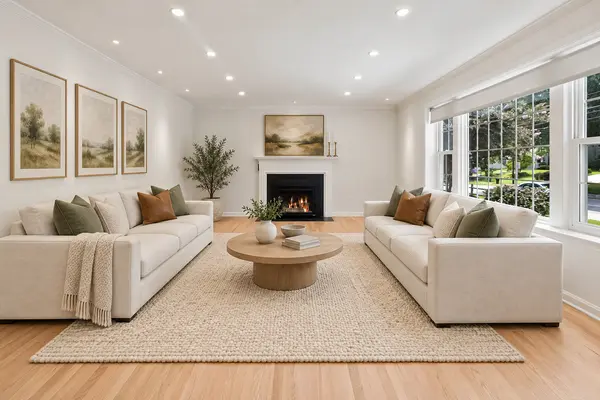
As an interior designer, I see the same pattern in many of these houses. The formal rooms are generous and well proportioned, while the kitchens, family rooms and primary suites were sized for a different era. The renovations that pay off open the back of the house, add a family room off the kitchen, and bring the primary suite up to today's expectations. I cover that trade-off in selling as-is versus renovating first and what a kitchen renovation is worth before you sell.
Spring Valley is not a historic district. Additions and replacement houses go through ordinary zoning and permitting rather than historic design review, which is one reason new construction keeps appearing here. That is a real difference from Georgetown, where exterior changes go through historic review by the Old Georgetown Board, the Commission of Fine Arts and the DC Historic Preservation Office.
The Numbers: Two Years Ending September 2026
These figures come from Bright MLS closed sales records for the Spring Valley subdivision, ZIP 20016, covering settlements from September 30, 2024 through September 9, 2026. "Houses" means every home that is not a condominium. Retrieved September 17, 2026.
Houses
| Measure | Result |
|---|---|
| Houses sold | 79 |
| Total sales volume | $251.0 million |
| Median sale price | $2,600,000 |
| Price range | $1,100,000 to $9,500,000 |
| Median days on market | 10 |
| Median sale price as a share of original asking price | 98.0% |
| Sold at or above original asking price | 37 of 79 (47%) |
| Median price per above-grade square foot | $839 |
| Median above-grade size | 3,588 sq ft |
| Median lot | 0.22 acre |
| Paid in cash | 42% |
Where the prices fall
| Sale price | Houses sold |
|---|---|
| Under $2,000,000 | 18 |
| $2,000,000 to $3,000,000 | 28 |
| $3,000,000 to $4,000,000 | 14 |
| $4,000,000 to $5,000,000 | 10 |
| Over $5,000,000 | 9 |
More than four in ten buyers paid cash, a sign of how many buyers here do not depend on a mortgage.
Existing houses and new construction
| Measure | Existing houses | New construction |
|---|---|---|
| Houses sold | 69 | 10 |
| Median sale price | $2,395,000 | $4,637,500 |
| Median price per above-grade square foot | $820 | $1,028 |
| Median days on market | 7 | 53.5 |
| Median share of original asking price | 100.0% | 94.5% |
| Sold at or above original asking price | 36 of 69 | 1 of 10 |
New construction commands a real premium here, about 25% more per square foot, because truly new houses in Upper Northwest DC are scarce. But at $3.5 million and up, the buyer pool is small. Nine of the 10 new houses sold below their original asking price, and the typical one took nearly two months.
For builders and for owners weighing a teardown, the lesson is to price new construction for the buyers who exist, not for the finishes. For buyers, new construction is where negotiating room is most likely. My guide to buying new construction in DC covers what to check before you commit.
Year built can mislead
Three of the 10 houses flagged as new construction carry a recorded year built between 1933 and 1953. That happens when a builder rebuilds or expands an older house and the county record keeps the original date. It is a good reminder that year built in MLS records often doesn't tell you what a house is today.
| Year built (per county record) | Houses | Median price | Median $/sq ft | Median days on market |
|---|---|---|---|---|
| Before 1940 | 20 | $3,425,000 | $843 | 4.5 |
| 1940 to 1959 | 31 | $2,600,000 | $929 | 7 |
| 1960 to 1999 | 19 | $2,100,000 | $633 | 15 |
| 2000 and later | 9 | $5,000,000 | $1,038 | 64 |
The original Miller-era houses, built before 1960, sold fastest and at full price. Houses from the 1960s through the 1990s sold for the least per square foot. That is often where buyers see the most room to renovate, and where sellers need the sharpest pricing.
The first two weeks still matter
| Time to contract | Houses | Median share of original asking price |
|---|---|---|
| 10 days or fewer | 40 | 100.0% |
| 11 to 29 days | 19 | 96.3% |
| 30 days or more | 20 | 92.6% |
About half of Spring Valley houses went under contract within 10 days, and those sold at their full original asking price. Houses that sat 30 days or more closed at a median 92.6%. On a $2.6 million house, that gap is close to $200,000.
The same pattern shows up in Chevy Chase and Wesley Heights. I explain how to use it in whether to price below market value in the DC metro.
The past year was slower
| Measure | 12 months ending Sept 2025 | 12 months ending Sept 2026 |
|---|---|---|
| Houses sold | 36 | 43 |
| Median sale price | $2,610,000 | $2,600,000 |
| Median days on market | 6.5 | 15 |
| Median share of original asking price | 100.0% | 98.0% |
More houses sold in the most recent year, and the median price held. But the typical house took more than twice as long to sell, and fewer sold at full price. Part of that is the mix: six of the 10 new-construction sales closed in the past year. Even among existing houses, though, the median time on market went from 6 days to 11, and the median sale slipped from 100% to 99.2% of asking.
Of the house listings that came on the market since September 2024, 37 expired, were canceled or were withdrawn. Some came back later and sold, but set against 79 closings, it shows how often the first price didn't work.
What is on the market now
As of September 17, 2026, Bright shows six active houses in Spring Valley, at a median asking price of $4,195,000 and ranging from about $2.3 million to $10 million. Seven more are under contract or pending. At the recent pace of about three and a half sales a month, that is under two months of inventory, but the active listings are weighted toward the top of the market, where buyers are fewer.
Spring Valley has very few condominiums: two sold in the past two years, both in older buildings.
The Army Cleanup: What Buyers Ask About
During World War I, the Army used land at and around American University for the American University Experiment Station, where it researched and tested chemical weapons. Much of what is now Spring Valley was part of that site. In 1993, a construction crew dug up buried munitions, and the U.S. Army Corps of Engineers has been investigating and cleaning up the area since then.
Here is where things stand, in plain terms:
- Soil. The Corps sampled soil on more than 1,600 properties and removed arsenic-affected soil from the 177 that needed it. The Corps reported that scheduled soil cleanup was complete in its 2020 project fact sheet.
- The main burial site. The largest cleanup, on a single residential property, was completed in 2021.
- Groundwater. The Corps issued its final groundwater decision in 2025, following a plan that proposed no further action.
- Ongoing review. The Corps completed its first five-year review of the cleanup in 2024 and continues to post updates on its Spring Valley project page.
For a specific house, buyers can ask the seller what they know and contact the Corps' Baltimore District about that property's history. Sellers should talk with their agent about how to address it in their disclosures.
Daily Life
Most errands happen at the shopping center on Massachusetts Avenue, a short walk for much of the neighborhood. The American University campus sits on the eastern edge, and Glover-Archbold Park and its trail are close by. Sibley Memorial Hospital is a short drive away.
The nearest Metro station is Tenleytown-AU on the Red Line, and Metrobus routes run along Massachusetts Avenue. Downtown Bethesda is a short drive north. My Bethesda page covers that market, and my Friendship Heights redevelopment post covers what is changing on upper Wisconsin Avenue.
Buying and Selling in Spring Valley
If you are selling an existing house, the market still rewards a well-prepared house priced correctly from the first day. Base that price on the last three months of closed sales, since the market has shifted over the past year. Decide with your agent whether a pre-listing inspection makes sense for your house, handle repairs before you go live, and present the house well. My concierge pre-listing approach and selling guide walk through the steps. For your bottom line, read DC transfer tax for sellers and seller net proceeds in DC, Maryland and Virginia, and before hiring an agent, see the questions worth asking a listing agent.
If you are selling new construction, expect a longer timeline and plan the pricing strategy around it. Fewer buyers shop at that level, and most will compare your house against every other new build in Upper Northwest DC and Bethesda.
If you are buying, well-priced existing houses still move within a week or two, so have your financing and inspection plans ready before you tour. Your best negotiating room is with new construction and with any house that has been on the market for a month or more. My buying guide and what happens after an offer is accepted cover the rest of the process.
You can browse current listings on my Spring Valley neighborhood page. I also work across Upper Northwest DC, including Wesley Heights, American University Park and the Palisades, and in Bethesda, Chevy Chase MD, Arlington, Alexandria and McLean.
Frequently Asked Questions
What is the median home price in Spring Valley, Washington DC?
Houses in Spring Valley, DC 20016 sold at a median $2,600,000 over the two years ending September 2026, according to Bright MLS closed sales records. Existing houses sold at a median $2,395,000, and new construction at a median $4,637,500.
How long do houses take to sell in Spring Valley?
The median house sold in 10 days over the past two years, but the past 12 months were slower, at a median of 15 days. Existing houses sold faster than new construction, which took a median of about 53 days.
Do homes in Spring Valley sell over asking?
Some do. Over the past two years, 37 of 79 houses sold at or above their original asking price. Houses that went under contract within 10 days sold at a median 100% of asking, while those on the market 30 days or more sold at a median 92.6%.
Is new construction in Spring Valley worth the premium?
New construction sold for about 25% more per square foot than existing houses, at a median $1,028 compared with $820. But nine of the 10 new houses sold below their original asking price, so buyers often have room to negotiate.
Is the Army cleanup in Spring Valley finished?
The major work is done. The Army Corps of Engineers completed the scheduled soil cleanup on affected properties and finished the largest burial-site cleanup in 2021, and it issued a final groundwater decision in 2025. The Corps continues to post updates on its Spring Valley project page, and buyers can contact its Baltimore District about a specific property.
Who built Spring Valley?
W.C. & A.N. Miller, the company that also built Wesley Heights and Sumner in Bethesda, developed Spring Valley beginning in the late 1920s. Most of its houses are Colonial Revival, set on curving streets that follow the terrain.
Is Spring Valley a historic district?
No. Houses in Spring Valley are not subject to historic design review, although the shopping center buildings on Massachusetts Avenue are DC landmarks.
Thinking About a Move in Spring Valley?
Whether you own an original Miller Colonial, are weighing a rebuild, or are looking for the right house to buy, I'd be glad to walk through the numbers for your street and your plans. Call or text me at 202.536.4043, email sherine@smdg-llc.com, or request a home value review. Sherine is here whenever you're ready.
Sources: Bright MLS closed sales records, Spring Valley subdivision, Washington DC 20016, settlements September 30, 2024 to September 9, 2026, and active listings as of September 17, 2026, retrieved September 17, 2026 (Bright MLS). History and cleanup information from the U.S. Army Corps of Engineers, Baltimore District, DVIDS, DCist, the DC Preservation League and the DC Office of Planning. Market data is not guaranteed and does not reflect every transaction.
About Sherine Monir
Sherine Monir is a Realtor with Compass and also a licensed Interior Designer in DC (NCIDQ, CID, ASID), with a master's degree in interior design from Marymount University. Licensed in DC, Maryland and Virginia since 2013, she has sold over 200 homes totaling more than $115 million and is ranked in the top 5% of DC Metro agents. She was named to RealTrends America's Best 2026 (top 1.5% nationally), is a Washingtonian Elite Producer and Bethesda Magazine Top Producer, and is a DC Real Estate Awards honoree. She represents sellers and buyers across Upper Northwest DC, Bethesda, Chevy Chase, Arlington, Alexandria and McLean. Compass, 1313 14th Street NW, Washington DC 20005. Office 202.386.6330.
Recent Posts