How Much Is DC Transfer Tax for Sellers in 2026?
How much is DC transfer tax for sellers in 2026?
DC sellers customarily pay a deed transfer tax of 1.1% on sales under $400,000 and 1.45% at $400,000 and above, applied to the full sale price.
If you are preparing to sell in Washington, DC, this is one of the first line items I walk my clients through. It is not the only closing cost, but because it scales directly with price, it is usually the single largest percentage-based charge on the seller's side of the settlement statement.
There is a second piece most sellers miss. DC collects two separate taxes at every closing, not one, and the second one is the buyer's responsibility. Knowing which one is yours, and which one is not, is the difference between an accurate net sheet and one that overstates your costs by half.
The Two DC Taxes: Deed Transfer and Deed Recordation
Most people talk about "the DC transfer tax" as a single thing. It is actually two taxes, both triggered at the same closing event, both administered by the DC Office of Tax and Revenue, and both calculated on the sale price.
They carry identical rates:
| Tax Type | Under $400,000 | $400,000 and Above | Paid By |
|---|---|---|---|
| Deed Transfer Tax | 1.1% | 1.45% | Seller |
| Deed Recordation Tax | 1.1% | 1.45% | Buyer |
| Total collected by DC | 2.2% | 2.9% | — |
Two details matter here.
First, the higher rate applies to the entire sale price once the threshold is met, not just the portion above $400,000. There is no graduated bracket. A sale at $410,000 is taxed at 1.45% on all $410,000.
Second, your side of the ledger is 1.45% — not 2.9%. The 2.9% figure is what the District collects in total across both parties. I see that number misquoted as a seller cost constantly, and it materially distorts a net sheet.
Why the $400,000 threshold is largely academic in Upper Northwest DC
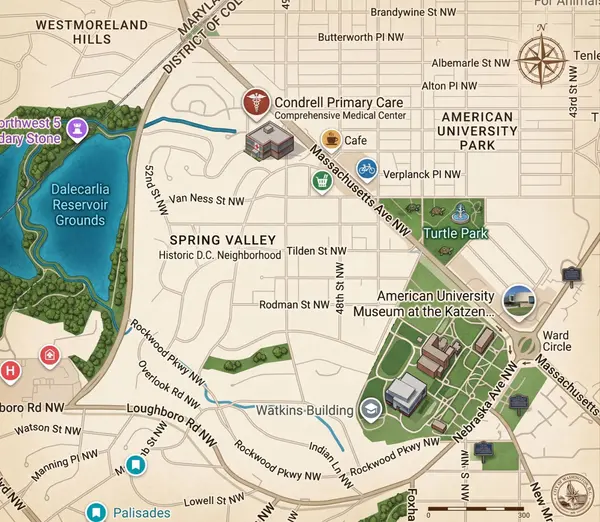
In Spring Valley, Wesley Heights, AU Park, Forest Hills, Tenleytown, North Cleveland Park, and Chevy Chase, the practical answer is simple: you are in the 1.45% tier. Detached homes and even most condominium units across the 20016 and 20015 ZIP codes clear $400,000 comfortably, so the threshold almost never comes into play.
The statute does not vary by neighborhood. It applies uniformly across every square in the District. What varies is price, and in Upper Northwest DC price is the reason the higher tier is effectively the only tier that matters.
Who Actually Pays: This One Is Settled
This is where I see the most confusion, and it is worth being direct about.
In a standard District resale, the split is not a negotiation. The Jurisdictional Addendum to the GCAAR sales contract — the contract used in essentially every DC transaction — assigns it outright: the buyer pays the deed recordation tax, and the seller pays the deed transfer tax. It is stated in the form as a term, not offered as a blank to fill in or a box to check. There is no back-and-forth over it, and no offer I have seen in Upper Northwest DC has tried to move it.
So when you are building your net sheet, plan on 1.45%. Do not budget for the possibility of shifting it to the buyer, and do not let anyone tell you the number might come down.
One place the picture does change is new construction. Developers regularly write their own allocation into their own contracts, and that provision is sometimes tied to using the developer's preferred title company and lender. If you are buying new construction in the District, read that language closely before you sign.
The related point worth understanding: a buyer asking for a seller credit toward closing costs is a different conversation entirely. That does not change who owes which tax — it changes the money moving across the table. Sellers sometimes conflate the two and think their transfer tax obligation is in play when it is not. The Consumer Financial Protection Bureau's closing disclosure guide is a useful reference for seeing how each of these lands as its own line.
The First-Time Buyer Reduction — And Why Sellers Should Care
Qualifying first-time District homebuyers can have their recordation tax reduced to 0.725%. For fiscal year 2026, which began October 1, 2025, the purchase price ceiling for an eligible property is $777,000, up from $753,000. Household income limits also apply, and both figures are adjusted annually.
Note that 0.725% is a flat rate. Unlike the standard recordation tax, it does not step up at $400,000 — a qualifying buyer pays 0.725% whether the house or condominium is priced below that threshold or above it. That means the benefit is worth more on higher-priced homes: a buyer under $400,000 saves 0.375% against the standard 1.1% rate, while a buyer above $400,000 saves the full 0.725% against the standard 1.45%.
Price is only half the test. There is also a household income ceiling, and it is not a single number — it scales with the number of people in the household, and it is adjusted every year alongside the price cap. The District looks at combined federal adjusted gross income for every buyer on the deed plus everyone who will live in the property, drawn from the most recent tax return filed before the deed is recorded. The applicant also has to be a District resident and a genuine first-time District homebuyer, meaning they have never owned DC property that received the homestead deduction.
Because both the price ceiling and the income table reset annually, no buyer should assume last year's numbers still apply. The current figures are published on OTR Form ROD 11, and any buyer who thinks they might qualify should confirm their own eligibility against that year's table with their lender or title company before writing an offer.
The transfer tax owed by the seller is unchanged by this program. Sellers still pay 1.1% or 1.45%.
So why does it matter to you as a seller? Because it changes buyer behavior at a specific price point. Because the reduction is flat, its dollar value climbs right up to the ceiling — on an eligible purchase at $770,000, a qualifying buyer saves roughly $5,600 against what they would otherwise owe. That is cash freed up on their side of the table. Above the ceiling, the benefit disappears entirely. When I am pricing a property near that line, it is a real consideration.
The application must be filed at the time the deed is recorded. It cannot be claimed afterward. Your title company handles it using OTR Form ROD 11, and the current year's income and price limits are published on the form itself.
What This Means for Your Net Proceeds
Because the tax is percentage-based, its dollar impact rises in a straight line with price. That is what separates it from flat charges. A recording fee is the same at $600,000 as at $1.6 million. The transfer tax is not.
At 1.45%, a $1,200,000 sale in AU Park carries $17,400 in seller transfer tax. At $2,000,000 in Spring Valley, it is $29,000.
I do not publish net sheets on a blog, because the right number depends on your sale price, prorated property taxes, any HOA or condominium transfer fees, title charges, and a handful of variables that shift with every transaction. If you want the fuller picture, I have written a companion piece on what actually reduces your net proceeds when you sell in the DC metro area. What I can tell you is that this line item deserves attention before you accept an offer, not after.
Which DC closing costs are fixed and which are negotiable
- Deed transfer and recordation taxes: Rates are set by DC statute, and the GCAAR contract assigns the transfer tax to the seller and the recordation tax to the buyer. Neither the rate nor the allocation is up for negotiation in a standard resale.
- Title insurance: Negotiable. Owner's and lender's policies are separate products with separate premiums.
- Settlement and escrow fees: Vary by title company. Not fixed by law.
- Prorated property taxes: Calculated from your closing date. The amount follows the calendar, not negotiation.
- HOA or condo transfer and resale package fees: Set by the association's governing documents.
One note for buyers on your side of the table: a purchase-money deed of trust recorded at the same time as the deed can qualify for an exemption from recordation tax on the loan amount, provided the statutory timing and form requirements are met.
Selling in DC Versus Maryland
DC's structure is entirely distinct from Maryland's and Virginia's. If you are weighing a sale in Chevy Chase against one across Western Avenue in Chevy Chase, Maryland, you are looking at two different tax regimes, two different recording systems, and two different rules on who pays what — for two homes that may be four blocks apart.
That border matters more than most sellers expect, and it is one of the reasons I stay licensed and active on both sides of it.
Frequently Asked Questions
How much is DC transfer tax for the seller in 2026?
The deed transfer tax, paid by the seller, is 1.45% of the sale price for properties at $400,000 and above, and 1.1% below that. The buyer pays a matching deed recordation tax at the same rate, so the District collects 2.9% in total on most DC sales.
Who pays transfer tax in DC, buyer or seller?
The seller pays the transfer tax and the buyer pays the recordation tax. The GCAAR Jurisdictional Addendum, used in essentially every District transaction, states this directly, so it is not a term the parties trade over in a standard resale. New construction contracts written by developers are the exception worth reading carefully.
Is the 1.45% rate only for homes above $400,000?
The rate drops to 1.1% below $400,000. Above the threshold, 1.45% applies to the entire sale price rather than only the amount over $400,000, so there is no graduated bracket to calculate.
Does DC transfer tax work differently in different neighborhoods?
No. The statute applies uniformly across every neighborhood in the District. The only practical difference is typical sale price, which determines which tier a transaction falls into. In Upper Northwest DC, effectively every sale falls in the upper tier.
Is DC transfer tax paid at closing or afterward?
At closing. Your title company or settlement agent collects both taxes as part of the settlement statement and remits them to the DC Office of Tax and Revenue on your behalf. You will not write a separate check to the District afterward.
Can a first-time buyer's tax reduction affect my sale?
Not your costs. The reduction applies only to the buyer's recordation tax, and nothing on the seller's side changes because of it — you still owe the full transfer tax of 1.1% or 1.45%, and every other line on your settlement statement stays exactly where it was. A qualifying first-time District homebuyer pays a flat 0.725% recordation tax on eligible property priced at or below the annual ceiling, which is $777,000 for fiscal year 2026, and the rate does not step up at $400,000 the way the standard rate does. Eligibility also depends on household income, which is capped on a sliding scale by household size and adjusted annually, so buyers need to check the current year's limits rather than relying on figures they saw previously. Where it can matter to you is the buyer's side of the table: a qualifying buyer needs less cash at closing, which can affect what they are able to offer if your home is priced near the ceiling.
Let's Talk Through Your Numbers
Knowing the rate is step one. Knowing exactly where it lands in your full net picture — alongside title charges, prorations, and everything else that moves between contract and settlement — is the conversation I have with every seller before we go to market. If you are still interviewing agents, here are 10 questions worth asking a listing agent before you sell in DC.
If you are thinking about selling in Upper Northwest DC, Bethesda, or Chevy Chase, call or text me directly at 202.536.4043 — or visit sherinemonir.com to get started.
Sherine is here whenever you're ready.
About Sherine Monir
Sherine Monir is a Realtor with Compass and also a licensed Interior Designer in DC, leading the Sherine Monir Group. She has served Upper Northwest DC, Bethesda and Chevy Chase, and Northern Virginia since 2013, and holds the NCIDQ certification along with CID and ASID credentials — bringing a designer's eye and market precision to buyers and sellers across DC, Maryland, and Virginia.
Compass Real Estate — Sherine Monir Group
1313 14th Street NW, Washington, DC 20005
m: 202.536.4043 | o: 202.386.6330
sherinemonir.com
Equal Housing Opportunity. Sherine Monir is licensed in DC, Maryland, and Virginia since 2013. Sherine Monir Group of Compass is a real estate agent affiliated with Compass. Compass is a licensed real estate broker under the name "Compass Real Estate" in the District of Columbia and under the name "Compass" in Virginia and Maryland.
This article is general information only and is not legal, tax, or financial advice. Tax rates and program limits change. Confirm your own closing costs, tax obligations, and net proceeds with your attorney, tax advisor, lender, or settlement officer.
Recent Posts